Wisconsin Campaign Slogans
A good slogan is a few words that a voter can say back to you after a single glance. A bad one is a paragraph on a sign, and no one reads it.
 Tony Ruffi9 min read
 Add as a preferred source on Google
This article covers how to write one for a Wisconsin local race, how to test it before you pay a printer, and where it should go. By the end of this article, you'll have a line you can trust and a list of the mistakes we see most.
Inside this article
What does a campaign slogan do for a local race?
It gives voters one reason to remember you. A slogan is a short line that sits next to your name on signs, mailers and your website. It doesn't win a race alone, but it helps a voter who has seen your name three times finally understand why it matters.
- Short enough to say in one breath, and to read from a moving car
- One idea only, not three issues squeezed into a line
- Plain words a neighbor would use, with no jargon
- Your name and office stay the biggest things on the sign
- It sounds like you, so you can say it at a door without cringing
- You tried it on five real voters before it went to print
In a big race, a slogan fights for space with a lot of ads. In a school board, city council or county board race, most voters know almost nothing about you. A good line is often the first thing they learn.
What did "I Like Ike" and "Morning in America" get right?
They said one thing, in plain words. "I Like Ike" was a button, three words long, and it asked nothing of the voter except a feeling. "Morning in America" gave voters a picture they could see. Both candidates won big, and both lines are still known more than 40 years later.
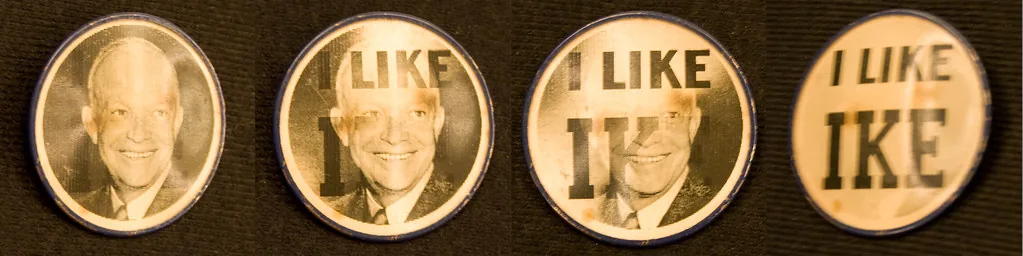
Dwight Eisenhower used "I Like Ike" in 1952 and won with 54.9% of the vote and 442 electoral votes, which are the state-by-state points that pick a president. Ronald Reagan's 1984 ad opened with "It's morning again in America," and the ad's own title was "Prouder, Stronger, Better." He won with 58.8% and 525 electoral votes. You can read how the ad was made in this summary of the "Morning in America" ad.
We're not saying a line wins an election. The vote totals above came from many things, and a slogan was one of them. What we take from both is how they were built:
- They were short. Three words, and a handful of words.
- They were warm. Neither one picks a fight.
- They fit a name or an idea. "Ike" was the man. "Morning" was the mood.
- They were used again and again, in the same way, until voters knew them.
A local candidate can do all four with one lawn sign.
How long should a slogan be?
Two to six words is a good target. Voters see a sign for about three seconds from a car, so every extra word makes the others harder to read. If you have to take a breath in the middle, it's too long.
Here's a quick way to see where a line lands:
| Length | What happens | Our take |
|---|---|---|
| 1 to 3 words | Easy to read, easy to remember | Best for signs |
| 4 to 6 words | Still works if the words are small and clear | Good for mailers and your website |
| 7 words or more | Voters skip over it | Cut it, or save it for a flyer |
Those lengths are our rule of thumb from years of signs and mailers, not a study. Your name does most of the work on a sign, so the slogan should never push it down in size.
What should a slogan say?
Think of your slogan as an elevator pitch. You get about five to ten seconds to tell a stranger who you are, and you don't get three to five minutes to explain what you stand for. Attention is short, and it's getting shorter, so the line has to do its job fast.
So start with one question: who are you? A parent, a business owner, a nurse, a coach, a lawyer, a longtime volunteer? Every role comes with traits in a voter's mind. A parent seems to have a big heart. A business owner seems like a go-getter, and some voters may also wonder if the dollar comes first. People often trust doctors and often don't trust lawyers. An activist can go either way, and it depends on your record. Pick the role you want voters to think of, because if you haven't figured out who you are, you can't tell anyone else.
Once you know that, say one thing, and it should be about the voter or the place, not you. "Fair" and "experienced" are the words every candidate picks, and voters hear them in every race. What you want is a line only you could put on a sign.
Here are four ways to find yours, with plain examples of the shape (these are made up to show the idea, not lines we've used):
- Say what you'll do. "Fix the roads first." It works when it's your main promise and you can keep it.
- Say who you're for. "Parents first." It tells a voter right away if the race is about them.
- Say who you are. "Born here. Raising kids here." It works best when it's true and local.
- Say how you'll act. "Show up. Listen. Vote." It's good for a first-time candidate with no record yet.
Look at the people who are running against you, and don't write the same line they did. If an opponent already owns "common sense," don't pick it too. Pick the idea that is true about you and that voters haven't heard on every sign in town. This is also why we tell candidates to own their story, because a slogan is a small piece of it.
Skip words no one says out loud. "Leadership," "vision" and "solutions" sound like a form letter. Say what you'd say to a neighbor at the fence.
How do you test a slogan before you print it?
Say it out loud to five real voters and ask what they think you want. If they can't tell you, change the line. It takes one afternoon and it saves you from printing hundreds of signs with a line that doesn't land. Here are the steps we use:
- Write three or four versions, not just one. Don't fall in love with the first.
- Pick five people who don't know your plan, and who aren't your family or paid staff.
- Show each one the line for three seconds, then take it away. Ask what the sign said and what the person is running for.
- Ask what they think you care about. If three of five get it wrong, change the line.
- Say it at a door. If it feels like a speech, it's the wrong tone for a campaign.
- Check the spelling, then have two other people check it. A typo on 500 signs costs more than any test.
One more check: look at the line next to your name, in the colors and fonts you'll really use. A line that works on paper can disappear on a sign.
Where does a slogan go, and what does the law ask for?
It goes everywhere voters see your name: yard signs, mailers, your website, your social posts and your door hangers. Use it the same way each time. If the slogan shows up on a printed campaign item, that item usually needs a "Paid for by" line too.
State law asks for that line on printed ads, billboards, handbills and similar items that urge a vote and were paid for by a campaign. For a candidate's committee, the words are "Paid for by" and the committee's name. The law also leaves out small items where the line can't conveniently be printed, and you can read it in Wis. Stat. § 11.1303. We go through the words and sizes in our article on Wisconsin paid for by rules.
Putting the slogan on a sign is a separate question from where the sign can go. Our yard sign rules article covers that part.
If you may run for a higher office one day, keep the colors, the font and the style the same, and change the words only when the office changes. Voters who know your look will spot you on a new sign. A new slogan on an old look still reads as you.
What do campaigns get wrong with slogans?
They try to say too much, they copy someone else, and they change the line halfway through the race. Those three cover most of the weak slogans we see, but they aren't the only ones. Here's the longer list we run through with every candidate:
- Three ideas in one line. Pick the one that counts most.
- A line that could fit any candidate. If you can swap in another name and it still works, it isn't doing its job.
- Changing it in October. Voters need to see a line many times. Starting over resets the count.
- A pun or a joke on the main sign. Save it for social posts, and only if it sounds like you.
- A slogan that doesn't match the website or mailer. The sign, the mailer and the site should look like the same person.
Here's one we saw up close. A candidate we worked with ran under a line that only named his political label. It told voters which side he was on and nothing else. We changed it to "Proud American." That one word choice moved him from a party line to the people he wanted to serve, and it matched how he actually worked. After he won, he sponsored and co-sponsored bills with members of both parties, and most of them passed with support from both sides.
Small races are close, so the details count. One client of ours won a village president race by 18 votes. In a race like that, the voters who remember your name can decide it. A clear line next to the name helps them remember.
Try it on a stranger
Before you spend a dollar, do this once. Write your best line on a card, and walk up to someone you don't know at the grocery store or the post office. Show them for three seconds. Then ask two questions:
- "What do you think this person is running for?"
- "What do you think they care about?"
If they get both right, you're done. If they don't, you just saved yourself a printing bill.
This article is general information, not legal advice. Laws and rules change, and your city or village may add its own. Before you print anything, check with the Wisconsin Ethics Commission, the Wisconsin Elections Commission and your filing officer, who is usually your clerk, to see what applies to your race.
Want someone to look at your slogan and your sign before they go to the printer? Talk to our consulting team. The first call is free, and we help candidates at every level, from school board to Congress & governor. Next, read how to beat an incumbent or put your line on a campaign website.
Asked about slogans
Does a local candidate even need a slogan?
No law says so, and some good campaigns use only the candidate's name and office. A short line still helps, because it gives voters a reason to remember you. If you can't make one that's clearly better than your name alone, skip it.
How many words should a campaign slogan have?
As few as it takes, and a good target is two to six. A slogan has to be read in a glance, from a car or a lawn. If you can't say it in one breath, cut it down.
Can I use a slogan another candidate already used?
Don't. Voters may think you are copying, and a famous line makes your race sound like someone else's. Some slogans may also be protected as trademarks, so ask a lawyer if you want to use a well-known one.
Does my slogan need a Paid for by line?
The line goes on the sign, mailer or ad that carries the slogan, not on the slogan itself. State law asks for it on most printed campaign items that urge a vote. It leaves out small items where it can't fit. Confirm the details with the Wisconsin Ethics Commission.
Should I use the same slogan for every race I run?
Keep the colors, the font and the style the same and change the words when the office changes. Voters who know your look will spot you on a new sign, even when the line says something new.
Can Bluejack help me write a slogan?
Yes. We work with candidates at every level, from school board to Congress & governor, on slogans, logos, signs and the plan to use them. Reach out for a free consultation and we'll talk through your race.
Fact-checked October 6, 2026 against Wis. Stat. § 11.1303 on docs.legis.wisconsin.gov; official 1952 and 1984 results from the American Presidency Project.
- Wis. Stat. § 11.1303, Attribution of political contributions, disbursements and communications, Wisconsin Legislature accessed Oct 6, 2026
- 1952 presidential election results, The American Presidency Project, UC Santa Barbara accessed Oct 6, 2026
- 1984 presidential election results, The American Presidency Project, UC Santa Barbara accessed Oct 6, 2026
- Draft Eisenhower movement and the 'I Like Ike' slogan, Wikipedia accessed Oct 6, 2026
- Morning in America (the 1984 'Prouder, Stronger, Better' ad), Wikipedia accessed Oct 6, 2026
- Local Candidates, Wisconsin Elections Commission accessed Oct 6, 2026