Wisconsin “Paid For By” Rules
A campaign sign is a cheap way to get your name in front of voters. One small line at the bottom of it trips people up. Wisconsin wants every paid political message to show who paid for it. Once the signs are printed, a missing or tiny line isn't something you can fix.
 Tony RuffiPublished Updated 6 min read
 Add as a preferred source on Google
This article covers which items need the line, the exact words, and how big it has to be. It also covers the rule for ads made with AI. By the end, you'll know what to check before you send anything to the printer.

On this page
What does “Paid for by” mean on a Wisconsin campaign sign?
It's a short line that tells voters who paid for a message. Wisconsin law says printed ads, billboards, handbills, sample ballots, and TV and radio ads must clearly show their source. That covers any that push a vote for or against someone, or for or against a referendum. For a candidate's committee, that means the words “Paid for by” and the committee's name. That's Wis. Stat. § 11.1303.
- The words“Paid for by” plus your committee's name. You can add your treasurer's name.
- When it's neededon messages that urge a vote, like “Vote for” or “Elect,” that a committee paid for.
- What's exemptbuttons, pens, pins & business cards, plus small items where the line can't fit.
- Type sizeat least 12-point on anything up to 24 by 36 inches, in a plain sans-serif font.
- Videothe line stays on screen for at least 4 seconds.
- AI adsads with AI-made audio or video need their own label.
“Wis. Stat.” is short for the Wisconsin statutes, the state's written laws. The law also bans paying for a message in a made-up name or in someone else's name. So the line has to be true, and it has to be there.
Which campaign items need the line, and which don't?
Most things you'd pay to print or air need it. The rule covers messages with what the law calls express advocacy. That means plain words that tell people how to vote, like “Vote for,” “Elect,” or “Defeat.” Here's how common items stack up.
| Item | Line needed? |
|---|---|
| Yard signs & billboards | Yes |
| Mailers, handbills & door hangers | Yes |
| Sample ballots | Yes |
| Radio & TV ads (spoken or shown) | Yes |
| Video ads | Yes, on screen 4+ seconds |
| Not on the exempt list, so we add it | |
| Text messages & social media posts | The law lists them as small items that may skip it |
| Small online ads | Only if the line can't fit and they link to a page with it or show it automatically |
| Buttons, pens, pencils, pins, business cards, tickets | No |
Those rules come from § 11.1303 and Wis. Admin. Code ETH 1.96, the Ethics Commission's rule on this. Voters look for the line, so we'd rather add it and not need it.
What words go on the line?
The words are “Paid for by,” then the name of the committee that paid. A local candidate's committee is the campaign group you set up when you filed your registration statement with your clerk. You may add your treasurer's name. If you use the committee's name, you can't shorten it or use an abbreviation.
For example: “Paid for by Jane Doe for School Board.” That name is made up, so use your own.
Outside groups that pay for more than $2,500 of express advocacy use their own name after “Paid for by.” Some also add “Not authorized by any candidate or candidate's agent or committee.”
How big does the line have to be?
The state gives sizes that count as proof the line is easy to read. Up to 8.5 by 11 inches, use at least 10-point type. Up to 24 by 36 inches, use at least 12-point. Bigger than that, letters must be at least 4% of the height. That's in ETH 1.96.
| Size of the piece | Smallest type that counts as readable |
|---|---|
| Up to 8.5 x 11 in. | 10-point |
| Over that, up to 24 x 36 in. | 12-point |
| Bigger | Letters 4% of the vertical height |
The same rule adds a few more points. Use a sans-serif font, a plain style with no little feet on the letters. Use black text on white, or colors that stand out at least as much as your biggest words. On video, keep the line up for at least 4 seconds. On radio, say it clearly.
A common 18 by 24 inch yard sign falls in the 12-point group. That's tiny next to a name in 200-point type. We tell candidates to go bigger than the minimum and run the line across the whole bottom of the sign.
Do ads made with AI need a label in Wisconsin?
Yes, if the ad urges a vote, talks about an issue to sway an election, or takes a side on a referendum, a question put straight to voters. The law calls AI-made audio or video synthetic media. Audio ads need the words “Contains content generated by AI” at the start and the end. Video needs a written label on screen the whole time the AI part plays.
The wording is “This video content generated by AI,” “This audio content generated by AI,” or “This content generated by AI,” depending on what the AI made. Breaking the rule on purpose can cost up to $1,000 for each violation. A label doesn't protect you from other election laws either.
How real campaigns get the line right
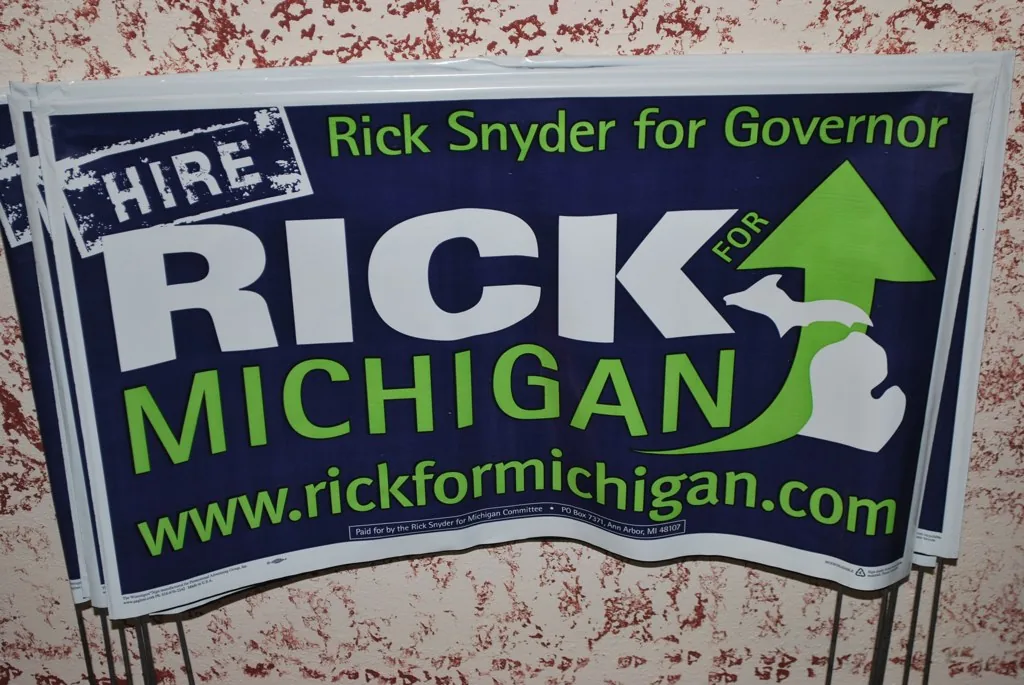
Rick Snyder won Michigan's 2010 race for governor with 58.1% of the vote, and his yard signs carried the committee's line at the bottom, as you can see above. Brent Jacobson won a 2024 State Assembly seat with 66% in a district that didn't exist before. Every sign, mailer and ad had to introduce him, and each one needed the right line. Even the famous I Like Ike button from 1952 would be exempt today, but signs aren't. Here's our short list:
- Register first. Your committee's name comes from your registration statement, which local candidates file with the city or town clerk. Copy the name exactly.
- Save the line once and paste it into every design, so no one retypes it.
- Go bigger than the minimum. Give it its own strip.
- Check the proof at real size. Print it and look from a few feet away.
- Hold the video line longer than 4 seconds.
- Put the line in email footers, social bios and your website's footer.
- Ask your city or town about sign rules. Where signs can go is a separate local question.
Running for Congress? Federal candidates follow federal rules, which are different from Wisconsin's.
This article is general information, not legal advice. Rules change. Confirm what applies to your race with the Wisconsin Ethics Commission, the Wisconsin Elections Commission and your filing officer, usually your clerk.
Print it right the first time
The “Paid for by” line is easy to get right before you print and costly to fix after. Register your committee, copy its name exactly, and make the line big and clear on every sign, mailer and ad. Then spend your energy on what wins votes.
Want a second set of eyes on your signs and mail before they go to the printer? Our campaign consulting team helps campaigns of every size get these details right, and the first conversation is free. You can also read our articles on Wisconsin nomination papers and running for school board, or browse more Running for Office articles.
Questions about the line
Do yard signs need a “Paid for by” line in Wisconsin?
Yes, if the sign urges a vote for or against someone and a campaign committee paid for it. State law says printed ads and billboards like that must clearly show who paid. For a candidate, the line reads “Paid for by” followed by your committee's name. Confirm the details with the Wisconsin Ethics Commission.
What does the line say for a local candidate?
It starts with the words “Paid for by,” then the name of your campaign committee, which is the group you set up when you registered with your clerk. You can add your treasurer's name. If you use your committee's name, don't shorten it or use an abbreviation.
How big does the line have to be on a yard sign?
The state's rule gives sizes that count as proof the line is readable. On anything up to 24 by 36 inches, it's at least 12-point type. It should be a sans-serif font, black on white or with equal contrast. Bigger than that is safer. Check ETH 1.96 for the full list.
Do social media posts and texts need the line?
The law lists text messages and social media posts among small items that don't have to carry it. Email isn't on that list. We still put the committee's name in profile bios, on landing pages, and in email footers, so voters can always see who's behind a message.
Do buttons, pens or business cards need it?
No. The Ethics Commission's rule lists business cards, buttons, pencils, pens, pins, skywriting and tickets as items that don't need a “Paid for by” line. Small online ads can skip it only if the line can't fit and they link to a page with it or show it automatically.
Do I have to label video or audio made with AI?
Yes, if it urges a vote, talks about an issue to sway an election, or takes a side on a referendum, and AI made part of the audio or video. Audio needs the words “Contains content generated by AI” at the start and end. Video needs a written label the whole time the AI part is on screen.
Last updated . Fact-checked September 30, 2026 against Wis. Stat. § 11.1303, Wis. Admin. Code ETH 1.96, and Wisconsin Ethics Commission guidance.
- Wis. Stat. § 11.1303, Attribution of political contributions, disbursements and communications; synthetic media accessed Sep 30, 2026
- Wis. Admin. Code ETH 1.96, Attribution requirements accessed Sep 30, 2026
- Attribution/Disclaimer Requirements, Wisconsin Ethics Commission accessed Sep 30, 2026
- Candidates, Wisconsin Ethics Commission accessed Sep 30, 2026
- Local Candidates, Wisconsin Elections Commission accessed Sep 30, 2026
- 11 CFR 110.11, Communications; advertising; disclaimers (federal candidates), eCFR accessed Sep 30, 2026
- Rick Snyder, Ballotpedia (2010 Michigan governor race result) accessed Sep 30, 2026
- Dwight D. Eisenhower Campaign Button, 1952-1956, The Henry Ford accessed Sep 30, 2026